
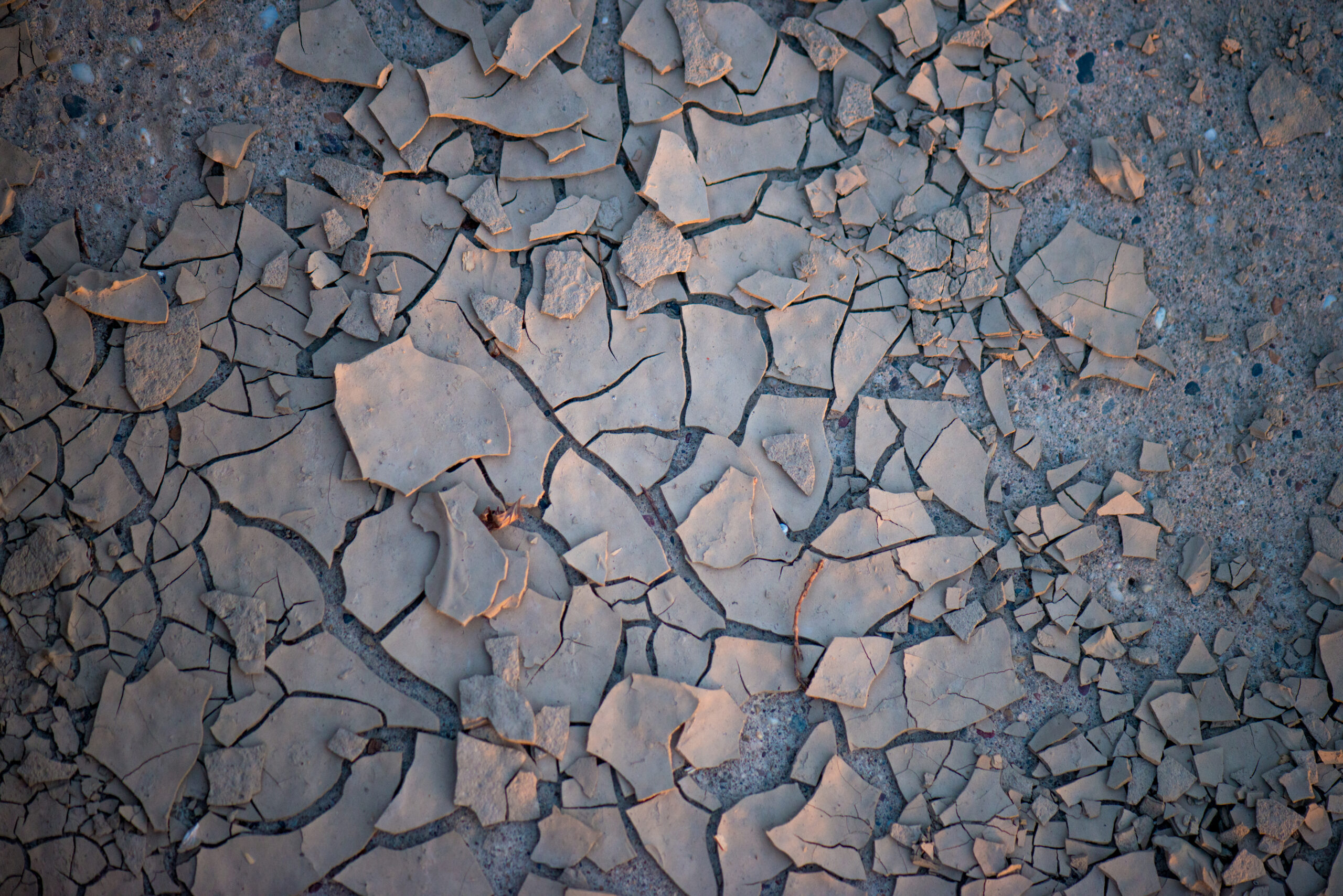
Porters Creek Clay is a Paleocene-age clay found across the South Gulf Coastal Plain, stretching through Arkansas, Mississippi, Tennessee, and beyond. Beneath its dense, fossil-rich composition lies a serious engineering challenge: a dramatic shrink–swell cycle following changes in moisture.
It’s a highly expansive material that cracks slabs, heaves structures, and warps highways. Mitigation strategies like chemical stabilization or overexcavation often fail due to the formation’s depth and composition. Instead, structural engineers specify structural solutions, such as void forms, to achieve long-term stability and protection.
For projects built on sites with Porters Creek Clay prone to dramatic shrink–swell cycles, here’s what you need to know to design structures that last.

What Is Porters Creek Clay?
Porters Creek Clay (also known as the Porters Creek Formation) was formed roughly 56–66 million years ago and has properties similar to Fuller’s earth. In addition to its commercially valuable absorptive and filtering properties, Porters Creek Clay contains abundant microfossils and well-preserved remains from ancient marine environments.
Appearance-wise, Porters Creek clay is dark gray to black, weathering to a lighter, nearly white color with exposure to the elements. It’s composed of up to 80% montmorillonite, a characteristic it shares with most other clays with strong shrink–swell behavior.[1] When excavated, Porters Creek Clay typically displays a blocky fracture pattern, a hallmark of its dense, highly reactive structure.
On the spectrum of soils with shrink–swell potential, the Porters Creek Formation has historically been ranked as only moderately expensive, including by the Federal Highway Administration.
However, in 2005, new testing determined that the “Porters Creek Formation has the same high potential for damaging shrink/swell behavior as other formations known to cause damage to roads and other engineered construction.”[2] This has forced the Federal Highway Administration to reconsider its expansivity ranking.

Where Is Porters Creek Clay Found?
Porters Creek is primarily found in the South Gulf Coastal Plain region, including:
- Arkansas
- Illinois
- Kentucky
- Mississippi
- Missouri
- Tennessee
The Porters Creek Formation varies in its characteristics from state to state. For example, around the Mississippi Embayment, the clay sits in a relatively thin layer, just three to 40 meters deep.[3] In Arkansas, it can reach up to 130 feet thick, and in the Cache River area of Illinois, deposits may be up to 150 feet deep.[4][5]

The Challenges of Porters Creek Clay for Construction
Although Porters Creek Clay may get less attention than other highly expensive soils, like Yazoo Clay and Blackland Prairie soil, it nevertheless poses a similar danger to structures built on top of it.

Due to its high plasticity index and shrink–swell behavior, Porters Creek Clay undergoes significant volume changes in response to moisture fluctuations in its surrounding environment. Seasonal weather, flooding, and human-made changes to the landscape can cause Porters Creek Clay to undergo dramatic cycles of swelling and shrinking.
As it absorbs moisture, the clay expands, exerting immense upward and lateral pressure beneath foundations, piers, walls, and roadways.[6] When conditions dry out, it contracts, often leaving unexpected voids and fissures that compromise the stability of above-grade structures.
As noted by The Kentucky Transportation Center, “Porters Creek Clay also creates design and constructability concerns for structures supported on piles,” specifically because of its dense, highly reactive structure.[7]
According to the center, foundation designs that require piles are often not possible “using common pile driving equipment.” Additionally, costly work may be required to pre-drive piles through the dense clay to ensure they effectively resist earthquake-induced damage and scour loads.
Effective Strategies for Building on
Porters Creek Clay
As with other types of expansive soil, mitigation strategies for Porters Creek fall into three categories: void forms, chemical stabilization, and overexcavation.
Void forms are the most practical and effective solution for long-term structural protection. Specified by the structural engineer following the results from the geotechnical report, void forms are installed beneath slabs, walls, beams, and piers to create a controlled buffer that accommodates the natural shrink–swell cycles. This specified void allows soil to expand without transferring pressure to the structure above.


VoidForm systems are designed to meet project-specific conditions and structural designs. SureVoid®, made from biodegradable paper cartons, provides a simple, cost-effective solution, while StormVoid®, a durable plastic form, ensures dependable performance in wet or unpredictable conditions common throughout the Gulf Coastal Plain.
Together, these systems maintain structural integrity even in one of the South’s most reactive soils.
Other mitigation strategies, including chemical stabilization and overexcavation, are not always effective or practical for managing the risk of Porters Creek Clay.
Overexcavation (the removal and replacement of reactive soil) is often impractical or unsafe due to the formation’s blocky fracture pattern and the depth of the deposit, which can exceed one hundred feet. Excavating beyond the seasonal moisture depth quickly becomes logistically and economically impossible, with hauling and refill costs exceeding the project budget.
The other alternative, chemical stabilization with lime or cement, is also unreliable in many environments. The high organic and sulfate content of Porters Creek Clay can interfere with the chemical reactions needed for stabilization, while its naturally acidic marine origins further inhibit chemical stabilization efforts.[8][9]
For these reasons, structural mitigation of Porter Creek Clay’s expansive nature with void forming offers a practical, scalable, and proven strategy for ensuring structural longevity.

Specify VoidForm To Protect Your Next Project
on Porters Creek Clay
If your next project sits on Porters Creek Clay, VoidForm delivers the proven protection your structure needs for long-term structural stability.
With manufacturing in Mississippi and distribution across North America, VoidForm delivers scalable, field-proven solutions for mitigating expansive soil.
Easy to order and backed by end-to-end support, VoidForm helps you protect your next project from the ground up.
- Historical: Porters Creek Formation. Illinois State Geological Survey. https://ilstratwiki.web.illinois.edu/wiki/Historical:Porters_Creek_Formation
- Demars, K. R., & Long, R. P. (1987). Rating the shrink–swell behavior of the Porters Creek Formation. https://www.researchgate.net/publication/250084056_Rating_the_ShrinkSwell_Behavior_of_the_Porters_Creek_Formation
- Gushing, E. M., Boswell, E. H., & Hosman, R. L. (1964). General geology of the Mississippi Embayment. U.S. Geological Survey Professional Paper 448-B. https://pubs.usgs.gov/pp/0448b/report.pdf
- Expansive soils in Arkansas. Arkansas Geological Survey. https://www.geology.arkansas.gov/geohazards/expansive-soils.html
- Historical: Porters Creek Formation. Illinois State Geological Survey. https://ilstratwiki.web.illinois.edu/wiki/Historical:Porters_Creek_Formation
- Kentucky geohazards and their impacts to highways and bridges. Kentucky Transportation Cabinet. https://library.seg.org/doi/pdf/10.4133/sageep.32-004
- Kentucky Transportation Cabinet. (2024, September 10). Kentucky geohazards and their impacts to highways and bridges. Highway Knowledge Portal. https://kp.uky.edu/knowledge-portal/articles/kentucky-geohazards-and-their-impacts-to-highways-and-bridges/
- Bhattacharja, S., Bhatty, J. I., & Todres, H. A. (2003). Stabilization of clay soils by Portland cement or lime—A critical review of literature. Portland Cement Association. https://www.cement.org/wp-content/uploads/2024/08/sn2066.pdf
- Manzoor, S. O., & Yousuf, A. (2020). Stabilisation of soils with lime: A review. Journal of Materials and Environmental Science https://www.jmaterenvironsci.com/Document/vol11/vol11_N9/JMES-2020-11133-Manzoor.pdf